
This is an old revision of the document!
Table of Contents
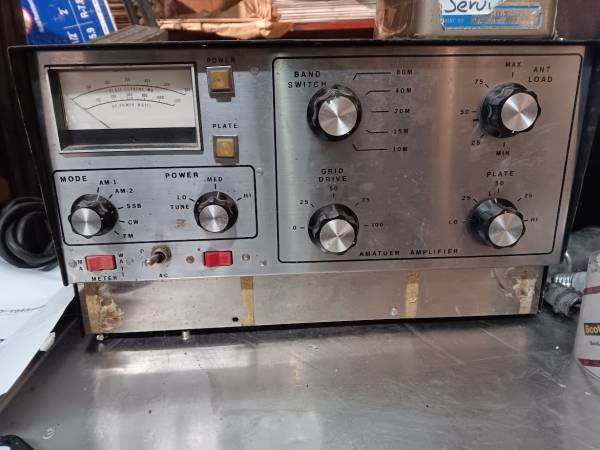
Technical Profile: Pride "Amatuer" Dual-Tube Amplifier
1. Unit Identification
- Manufacturer: Pride Electronics (California). Hy-Gain and Sonar Communications also used similar hardware
- Model: Likely a DX-3000 or a high-power variant of the KW-ONE.
- Production Era: Late 1970s.
- Defining Characteristics:
- “AMATUER AMPLIFIER” typo on the brushed metal faceplate.
- Red rocker switches for Power/Meter functions, riveted directly into the faceplate.
- Rectangular chassis wider than the standard DX-300/KW-1 “cube” design.
- Evidence of a missing adhesive-backed nameplate on the lower front panel.
2. Internal Architecture
- Vacuum Tubes: Two (2) 4CX250B (or similar) ceramic power tetrodes mounted in parallel.
- Cooling: Centrifugal squirrel-cage blower designed for a pressurized plenum.
- Power Supply: * Massive high-voltage plate transformer showing surface oxidation.
- Separate filament/control transformer.
- RF Deck: * Large ceramic multi-tap tank coil for band switching (80M through 10M).
- Dual variable capacitors for PLATE and ANT LOAD tuning.
- Parasitic suppressors (resistor/inductor combos) connected to the tube anodes.
3. Current Fault Analysis
The unit reportedly operates but is limited to 100 Watts output. Potential “Cold Test” targets include:
| Component | Symptom | Suspected Issue |
|---|---|---|
| Parasitic Suppressors | Darkened/Cooked appearance | Resistor failed open; choking RF output path. |
| Input Swamp Bank | Resistor cluster near input | Drifting high or incorrect bypass “hack” limiting grid drive. |
| Mode/Tune Logic | Stuck in “Tune” or “AM-1” | Internal relay or rocker switch failing to engage high-bias state. |
| Tube Health | Visual debris in cooling fins | Tubes may have “gone soft” due to overheating. |
| Transformers | Surface rust on laminations | Potential insulation breakdown from moisture. |
4. Testing Objectives (Cold State)
- Objective 1: Use LCR meter to verify parasitic suppressor resistors (target ~47-100 Ohm).
- Objective 2: Check input attenuator resistors for value drift.
- Objective 3: Inject low-level RF via signal generator to trace signal loss through the band switch and grid drive circuit.
- Objective 4: Manually inspect blower rotation and clear debris from tube cooling fins.
- Objective 5: inspect and test passives under chassis.
- Objective 6: Perform out-of-circuit testing of each tube, filament characteristics, micro-mhos where possible


later on
- hot testing at lowered voltages with dummy load, measurement of all key power supply points and cathode, grid, suppressor and plate on the tubes as well as output and tuning.
- hot testing ramped up
out of scope (for now):
- resistor bypass switch
- 240V operation
The presence of an FM setting on the mode switch is a significant clue that narrows the origin of this amplifier considerably. While most amateur amplifiers only featured SSB and CW, an FM option reveals several key things about the unit's design and intended market:
1. Class C Bias Capability The Technical Shift: In FM mode, an amplifier does not need to be “linear” because FM is a constant-envelope signal.
Efficiency: This setting likely switches the 4CX250B tubes from Class AB (linear for SSB) to Class C.
The Result: Class C is much more efficient and allows the tubes to run cooler while producing more power, which is ideal for the 100% duty cycle of FM transmissions.
2. Market and “Export” Origins The CB/11-Meter Connection: In the late 1970s, FM was not a common mode for hams on HF, but it was becoming popular in the “Export” CB market (especially in Europe and South America).
Pride’s Strategy: Including FM on a unit labeled “AMATUER” was a way for Pride Electronics to appeal to a global market that used FM on the 11-meter and 10-meter bands.
VHF/UHF Potential: Some 4CX250B amplifiers were designed for 2-meter (VHF) use where FM is the primary mode; however, the presence of an 80M–10M Band Switch confirms this is an HF unit with specialized FM circuitry added.
3. Connection to Your 100-Watt Issue The Relay/Switch Logic: If the mode switch is internally damaged or carbon-tracked, the amplifier might be physically stuck in the FM or AM-1 bias state.
Bias Bottleneck: If the unit thinks it is in a low-power “Tune” or “Low-Bias FM” mode, it will provide a very “stiff” ceiling on your output, resulting in that persistent 100-watt reading regardless of drive.
4. Comparison to Other Brands Sonar and Hy-Gain: While Sonar and the Hy-Gain “Afterburner” series were professional, they rarely included a dedicated “FM” position on their HF amplifiers.
Pride Signature: This specific “Mode” layout—AM-1, AM-2, SSB, CW, FM—is a definitive fingerprint of Pride Electronics' later, most versatile production runs.