
kg7vfo:start
This is an old revision of the document!
Table of Contents
Technical Profile: Pride "Amatuer" Dual-Tube Amplifier
1. Unit Identification
- Manufacturer: Pride Electronics (California).
- Model: Likely a DX-3000 or a high-power variant of the KW-ONE.
- Production Era: Late 1970s.
- Defining Characteristics:
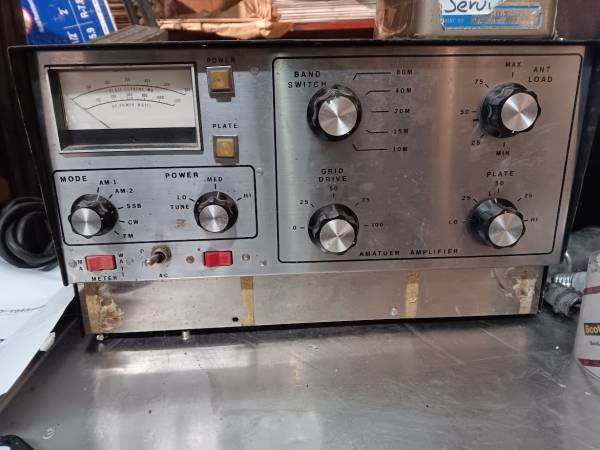
- “AMATUER AMPLIFIER” typo on the brushed metal faceplate.
- Red rocker switches for Power/Meter functions, riveted directly into the faceplate.
- Rectangular chassis wider than the standard DX-300/KW-1 “cube” design.
- Evidence of a missing adhesive-backed nameplate on the lower front panel.
2. Internal Architecture
- Vacuum Tubes: Two (2) 4CX250B (or similar) ceramic power tetrodes mounted in parallel.
- Cooling: Centrifugal squirrel-cage blower designed for a pressurized plenum.
- Power Supply: * Massive high-voltage plate transformer showing surface oxidation.
- Separate filament/control transformer.
- RF Deck: * Large ceramic multi-tap tank coil for band switching (80M through 10M).
- Dual variable capacitors for PLATE and ANT LOAD tuning.
- Parasitic suppressors (resistor/inductor combos) connected to the tube anodes.
3. Current Fault Analysis
The unit reportedly operates but is limited to 100 Watts output. Potential “Cold Test” targets include:
| Component | Symptom | Suspected Issue |
|---|---|---|
| Parasitic Suppressors | Darkened/Cooked appearance | Resistor failed open; choking RF output path. |
| Input Swamp Bank | Resistor cluster near input | Drifting high or incorrect bypass “hack” limiting grid drive. |
| Mode/Tune Logic | Stuck in “Tune” or “AM-1” | Internal relay or rocker switch failing to engage high-bias state. |
| Tube Health | Visual debris in cooling fins | Tubes may have “gone soft” due to overheating. |
| Transformers | Surface rust on laminations | Potential insulation breakdown from moisture. |
4. Testing Objectives (Cold State)
- Objective 1: Use LCR meter to verify parasitic suppressor resistors (target ~$47-100 Ohm).
- Objective 2: Check input attenuator resistors for value drift.
- Objective 3: Inject low-level RF via signal generator to trace signal loss through the band switch and grid drive circuit.
- Objective 4: Manually inspect blower rotation and clear debris from tube cooling fins.


kg7vfo/start.1766944499.txt.gz · Last modified: (external edit)